
© MU of Prespa National Park and PAs of Western Macedonia -NECCA
- High -level segmentThe High Level Segment consists of the Ministers of Environment of the three States Parties and the representative of the EU, who are due to meet every two years to assess progress in the implementation of the Agreement and define priorities for joint work.
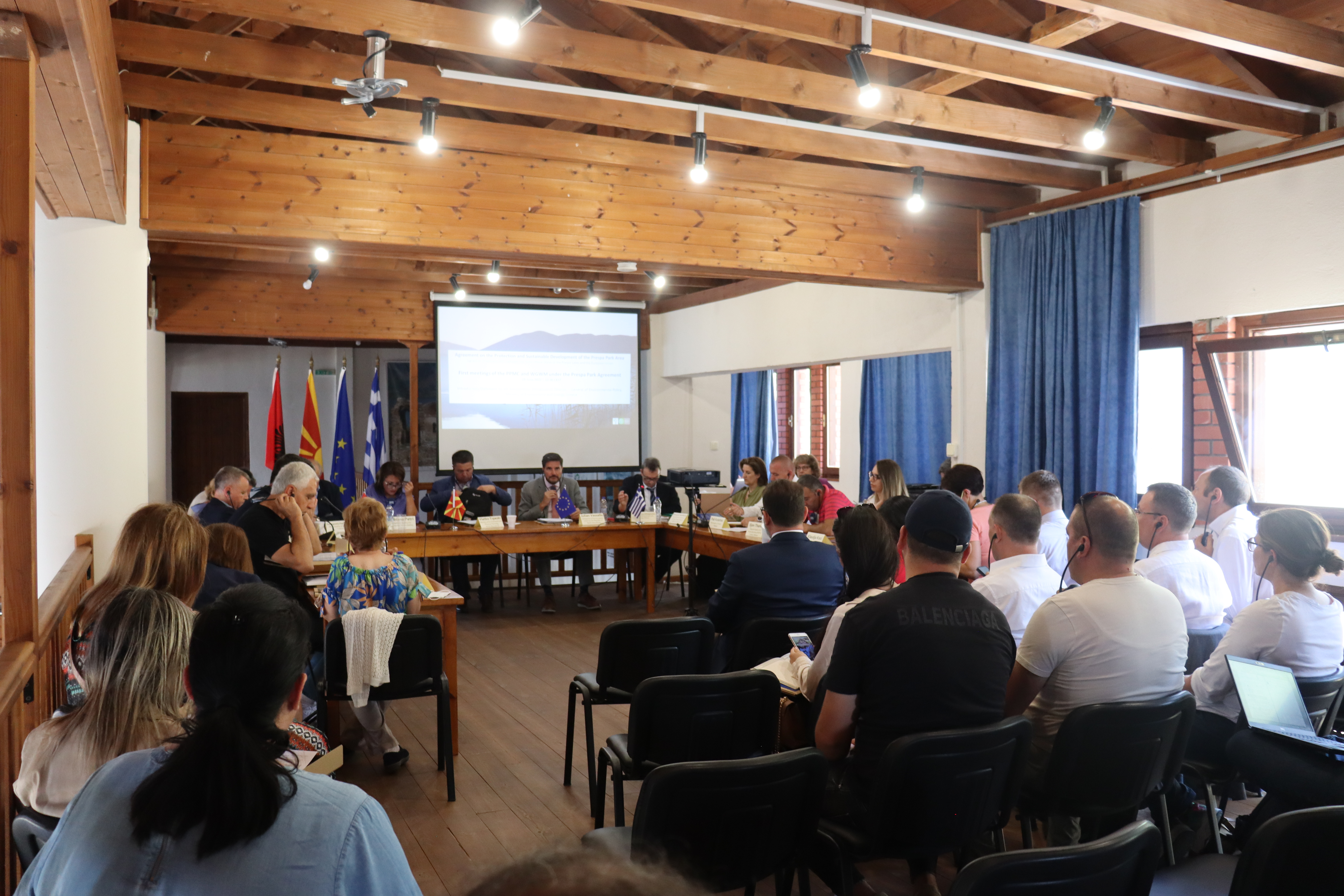
- Prespa Park Management Committee (PPMC)
- The PPMC is composed of representatives of the Ministry of Environment of each State Party and one representative of the European Union; of the local communities of the Prespa area from each State Party;
- of the environmental non-governmental organizations (NGOs) from each State Party, which have significant local action in the Prespa area; and of the local protected area management agencies from each State Party.
- Two permanent observers from the Med Wet Initiative and the Ramsar Convention for the Protection of Wetlands, and from the Ohrid Management Committee also participate in the PPMC.
The Committee meets twice a year to:
- Monitor and coordinate the activities that take place for the protection and sustainable development of the Prespa Park Area in implementation of the Agreement and the Strategic Action Plan for the Sustainable Development of the Prespa Park.
- Identify and recommend to the Parties and other interested partners the next steps and the necessary actions, measures and activities for the implementation of the Agreement, and invite them to cooperate, coordinate and execute joint programs.
- Provide recommendations and opinions on:
- (a) the drafting and application of standards, environmental criteria and requirements, which will serve as the basis for accomplishing integrated protection and sustainable development of the Lakes and their watershed;
- (b) the completion of the regulatory framework of the watershed area, including spatial plans and protected area regulations and management plans;
- (c) the drafting and application of strategies, integrated management plans and programmes to be implemented in the Prespa Park Area, which affect or may affect the achievement of the objectives of this Agreement;
- (d) the application of a programme of effective monitoring in order to observe, manage and control the state of the environment and the status of surface and ground waterbodies;
- (e) the definition of priority directions and programmes of scientific study and research for the protection and sustainable development of the Prespa Park Area and the promotion of publication of expert information;
- (f) the gathering, elaboration and publication of environmental information on the Prespa Lakes Area;
- (g) the promotion of public, NGO and other stakeholders’ participation in the protection of the Lakes and their watershed;

© MU of Prespa National Park and PAs of Western Macedonia -NECCA

© MU of Prespa National Park and PAs of Western Macedonia -NECCA
4. Facilitate the coordination of planning and activities of transboundary significance by the local protected area management bodies of the three States involved.
5. Evaluate the results of ongoing actions and disseminate its findings widely.
6. Act as the steering committee for programs and projects concerning the region.
7. Identify and propose possible sources of funding at national, European and international level, for the necessary actions, measures and programs.
8. Collect all available information about the Lakes and the watershed, request and receive proposals from government institutions, bodies and NGOs, in order to improve its work and increase the commitment of the parties to the implementation of the Agreement.
9. Prepare and Publish an annual report on the state of the environment of the Prespa Park Area, including a part describing the Committee's work.
10. Liaise with the Ohrid Management Committee, and coordinate action, in order to achieve the best results in terms of the protection and sustainable development of the wider area.
11. Contribute appropriately to the dialogue process for the sustainable management of the extended Drin basin.
12. Contribute to the mobilization of resources of the Parties and the international community, as deemed appropriate, for risk management and mitigation of negative impacts, in the event of unforeseen events, such as floods, forest fires and other natural or man-made disasters, as well as for protection of vulnerable ecosystems of the Prespa Park Area and their functions and services from the effects of climate change.
5. Evaluate the results of ongoing actions and disseminate its findings widely.
6. Act as the steering committee for programs and projects concerning the region.
7. Identify and propose possible sources of funding at national, European and international level, for the necessary actions, measures and programs.
8. Collect all available information about the Lakes and the watershed, request and receive proposals from government institutions, bodies and NGOs, in order to improve its work and increase the commitment of the parties to the implementation of the Agreement.
9. Prepare and Publish an annual report on the state of the environment of the Prespa Park Area, including a part describing the Committee's work.
10. Liaise with the Ohrid Management Committee, and coordinate action, in order to achieve the best results in terms of the protection and sustainable development of the wider area.
11. Contribute appropriately to the dialogue process for the sustainable management of the extended Drin basin.
12. Contribute to the mobilization of resources of the Parties and the international community, as deemed appropriate, for risk management and mitigation of negative impacts, in the event of unforeseen events, such as floods, forest fires and other natural or man-made disasters, as well as for protection of vulnerable ecosystems of the Prespa Park Area and their functions and services from the effects of climate change.
- PPMC Secretariat
The PPMC Secretariat consists of one representative from each State Party, appointed by the Ministry of Environment and headed by an expert in transboundary cooperation on protected areas and river basin management to be chosen by the Committee through an international call for applications. The Secretariat shall have the following tasks to be performed with the limits of budget availability:
- Prepare the annual work program of the PPMC
- Prepare or support the preparation of meetings
- Facilitate consultations on policy and other Agreement-related issues between social partners
- Collect, evaluate and disseminate data and information on legislation, measures and activities that have or may have a significant impact on the achievement of the Agreement’s objectives
- Monitor the implementation of common programs
- Collect, evaluate, publicize, and promote scientific research and collaboration in the Prespa Park Area
- Hold contacts and meetings with donors,
- Translate important documents,
- Represent the Committee in international fora,
- Any other duty assigned by the Committee
- Working Group on Water Management
The WGWM consists of a total of 7 members, including:
- one representative of the national water services (or equivalent administrative entity) of each of the three State Parties who may be assisted by national experts,
- one representative of the regional water services (or equivalent administrative entity) of each of the three State Parties,
- one representative from the European Commission, DG ENV, Water Unit (or relevant regional Commission official)
- Working Group on Sustainable Tourism (WGST)
The WGST is a standing expert group of the PPMC and it is composed of representatives from the tourism ministries, local authorities and protected area authorities of the three countries and a representative of the European Commission. The WGST is tasked with assisting the PPMC and the Parties in formulating and implementing a common tourism strategy.
This objective will be pursued by issuing recommendations based on the principles of sustainable tourism, by organizing consultations with local, regional and national stakeholders and exchanges of best practices. In this context, the WGST will also facilitate cooperation, support project development and collaborate in developing ideas to promote Prespa as a sustainable tourism destination.